
McKinley County Criminal Court Records
A criminal court record is the case file kept by the court after criminal charges are filed. In McKinley County, that file may begin in Magistrate Court, Municipal Court, or District Court depending on the offense and charging path. Felony cases move through District Court after preliminary or charging steps. Magistrate Court handles misdemeanors, DWI/DUI, traffic offenses, and felony preliminary hearings. Gallup Municipal Court handles city petty misdemeanors, municipal traffic, DWI, code enforcement, animal-control violations, and city arrests. Each court creates docket entries that track the case from filing to outcome.
The criminal court file is broader than the charge itself. It may contain the complaint, criminal information or indictment, bond documents, arraignment minutes, plea paperwork, motions, hearing notices, docket entries, sentencing order, probation terms, and post-conviction filings. The charge details are important, but the full criminal case file is where the reader checks how the charge changed, whether a plea or verdict was entered, and what sentence or disposition resulted. Charge-focused details fit better with the separate McKinley County arrest records and court charges path.
Search McKinley County Criminal Court Records
New Mexico Case Lookup is the primary free public search tool for criminal case information. It covers New Mexico appellate courts, District Court, Magistrate Court, and limited Municipal Court data. For McKinley County criminal court records, a user can search by defendant name, driver license, date of birth, case-number components, court type, court location, case category, and filing or hearing dates. McKinley-related location codes in the research include 1113 for Gallup District, 35 for Gallup Magistrate, 36 for Thoreau Magistrate, and 102 for Gallup Municipal.
Case Lookup does not provide document images. It can help confirm that a criminal case exists, identify the court, read the docket trail, check public hearing dates, and see public status information. For documents, use re:SearchNM when registration and user profile access allow it, or request records from the court. The Eleventh Judicial District public records page also points to court public-record channels for McKinley County.
- Open Case Lookup and accept the disclaimer for individual court-record viewing.
- Search by defendant name, date of birth, driver license, or exact case number.
- Limit the result by District, Magistrate, or Municipal court and the McKinley location code if known.
- Review the case category, docket events, pleas, dispositions, sentencing entries, warrants, and hearing dates.
- Use re:SearchNM or the court clerk when the docket confirms a filing but the document itself is needed.
Older criminal cases may need direct court help. Case Lookup notes that cases filed before statewide court automation was completed in June 1997 may exist in a separate database depending on the court. Juvenile criminal cases are not displayed on Case Lookup effective July 1, 2007.
McKinley County Criminal Case Flow
Criminal court records should be read as a sequence. A case can start with a complaint, information, indictment, citation, or other charging document. The arraignment records the formal reading of charges and plea or bond issues. Pretrial entries can include motions, continuances, discovery-related matters, warrants, or orders. The case may then resolve by plea, trial, dismissal, or another disposition. Sentencing entries show the penalty imposed after conviction, including jail, prison, probation, fines, fees, costs, treatment terms, or other court orders when public.
Case flow: Charges Filed › Arraignment › Pretrial and Motions › Plea or Trial › Disposition › Sentencing
| Stage | What Happens |
|---|---|
| Charges Filed | The complaint, information, indictment, or citation opens or moves the criminal matter into court. |
| Arraignment | The charge is stated, and plea, bond, counsel, or release issues may be addressed. |
| Pretrial and Motions | The docket may show motions, orders, continuances, warrant entries, and hearing settings. |
| Plea or Trial | The record may show a guilty, not guilty, no contest plea, trial setting, verdict, dismissal, or amended charge. |
| Disposition | The outcome of the charge or case is entered, such as dismissed, guilty, acquitted, or otherwise resolved. |
| Sentencing | The court enters penalties, probation terms, fines, fees, treatment terms, or custody commitments when applicable. |
What McKinley County Criminal Records Show
The public criminal case file identifies the court and case before it describes the outcome. Case Lookup and court records can show the court type, court location, case category, formatted case number, party name, filing date, hearing date, status, and docket activity. Criminal records can also show financial data for fines, costs, fees, bond, bench-warrant fees, and payment compliance when those entries exist in the case. The legacy public search shows docket and case data, not the images of the filings.
| Field | What It Shows |
|---|---|
| Case Number | The court type, location code, case category, year, and sequence, when fully formatted. |
| Defendant | The public party name used for name search and case display. |
| Court | The District, Magistrate, or Municipal court handling the criminal case. |
| Charges | The filed criminal accusations, which may later be amended, reduced, dismissed, or resolved. |
| Docket Events | Filings, hearings, motions, orders, continuances, warrant entries, dispositions, and sentencing entries. |
| Plea | The defendant's formal answer, such as guilty, not guilty, or no contest, when public and entered. |
| Disposition | The outcome of a charge or case, including dismissal, conviction, acquittal, or other final action. |
| Sentence | The penalty imposed after conviction, including custody, probation, fines, costs, or treatment conditions. |
| Documents | Not displayed in legacy Case Lookup; re:SearchNM or a court request may be needed. |
McKinley County Charges vs Convictions
A charge is an accusation filed in court. A conviction is an outcome after a guilty plea, no contest plea accepted by the court, or verdict. McKinley County criminal court records can show charges that did not end in conviction. A charge may be dismissed, amended, reduced, or resolved in a way that changes the final record. For that reason, the docket should be read through the disposition and sentence, not just the first charge line.
| Point | Charge | Conviction |
|---|---|---|
| Meaning | A filed accusation by complaint, information, indictment, or citation. | A final finding or plea that results in guilt under court process. |
| Timing | Appears near the start of the case or after amendment. | Appears after plea, trial, or final disposition. |
| Record use | Shows what was alleged, not what was proven. | Shows the outcome that supports sentencing entries. |
| Possible change | Can be reduced, amended, dropped, or dismissed. | May be followed by sentence, probation, appeal, sealing, or expungement request. |
The broader set of case types and court-record channels is covered in McKinley County court records, while this criminal section stays focused on the court's criminal case file and outcome.
McKinley County Sentencing Records
Sentencing entries should be read with the disposition. A guilty plea or verdict may be followed by jail, prison, probation, fines, fees, court costs, treatment terms, or other conditions. District Court felony records may include sentencing orders and probation terms. Magistrate and Municipal Court records may include fines, court costs, bond, bench-warrant entries, payment compliance, and DWI or traffic-related terms when the case type supports them. A sentence can also lead to later docket entries, such as probation review, revocation, satisfaction, appeal, or post-conviction filings.
The New Mexico Corrections Department Offender Search is included in the manifest for criminal court records because it helps distinguish a court sentence from state prison, probation, or parole custody records.
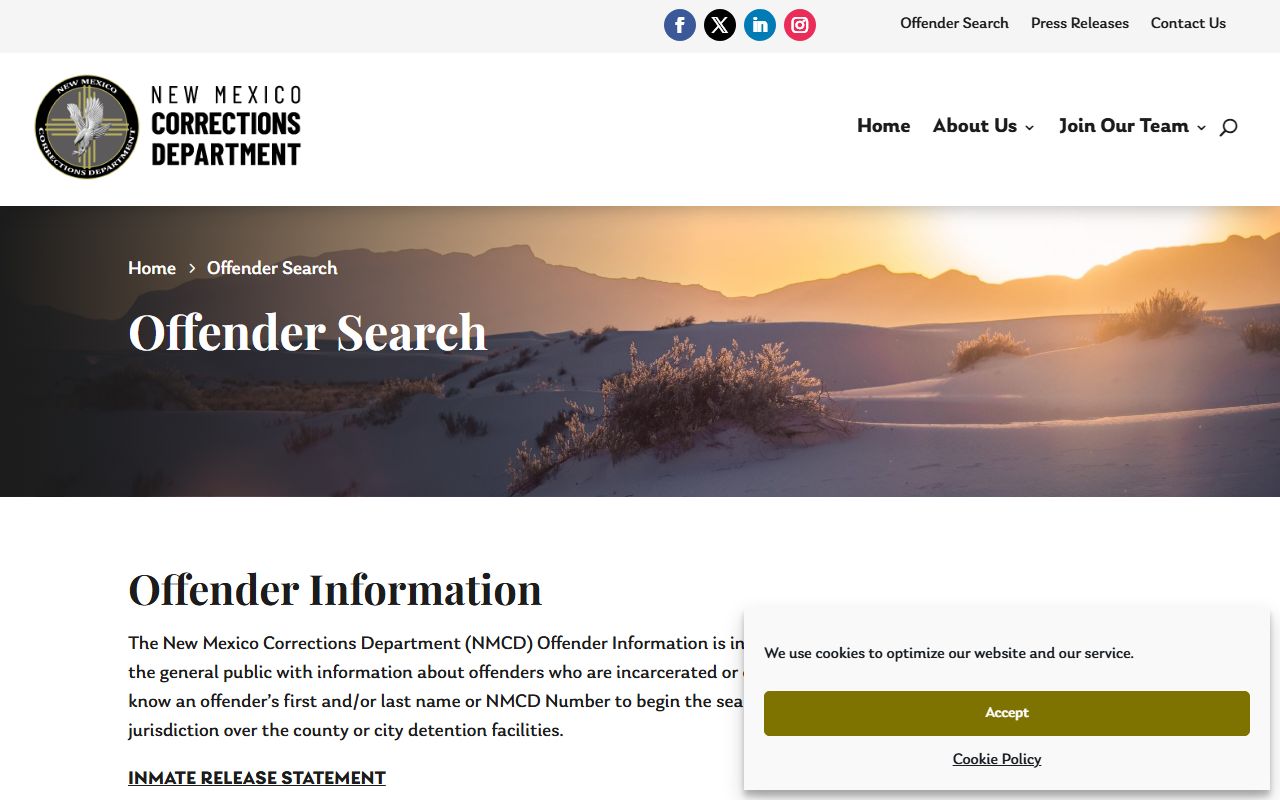
NMCD is not a county criminal court record source and does not cover county or city jails, but it may become relevant after a court sentence places a person in state correctional custody or supervision.
Public Access to McKinley County Criminal Records
New Mexico public access starts with the Inspection of Public Records Act and court-specific rules. NMSA 1978 Section 14-2-1 states that every person has the right to inspect public records unless an exception applies. Section 14-2-1.1 allows redaction of protected personal identifiers. Section 14-2-12 addresses IPRA enforcement. Court records also follow Rule 1-079 NMRA, which treats court records as public unless sealed by order or otherwise protected.
Public access does not mean every criminal record detail is online. Case Lookup excludes juvenile criminal cases effective July 1, 2007 and does not show Family Violence Protection Act order-of-protection cases effective July 1, 2008. It does not show Social Security numbers, address information, or document images. re:SearchNM has tiers for criminal, civil, family, probate, delinquency, and strict-confidentiality matters. District Court and Magistrate data are updated every day and current within 24 hours of entry, but an entry can still be restricted, redacted, sealed, or absent because of age or system limits.
Note: A public docket may confirm a criminal case, but document copies still come from re:SearchNM or the court.
McKinley County Sealed vs Expunged Records
Sealing and expungement affect access in different ways. A sealed record is hidden from ordinary public access by rule, statute, or court order. An expunged record is removed from general public access under the Criminal Record Expungement Act after the court grants relief. The DPS expungement overview says the act took effect January 1, 2020 and covers qualifying criminal and related public records under Sections 29-3A-1 through 29-3A-7. The practical path is court-based, not informal removal by a clerk, sheriff, or website.
| Point | Sealed | Expunged |
|---|---|---|
| Public visibility | Hidden from ordinary public access when protected by rule, statute, or order. | Removed from general public access if the court grants expungement. |
| How it happens | By court rule, statute, or judge's sealing order. | By petition under the Criminal Record Expungement Act. |
| Common examples | Juvenile, protection-order, adoption, mental health, and other restricted matters. | Qualifying non-conviction or conviction records after statutory findings. |
| Public search effect | May block display or require authorized access. | Removes the qualifying criminal record from general public access after order service. |
The New Mexico Department of Public Safety expungement page is the manifest source for the image below and provides the statewide expungement context for McKinley County criminal court records.
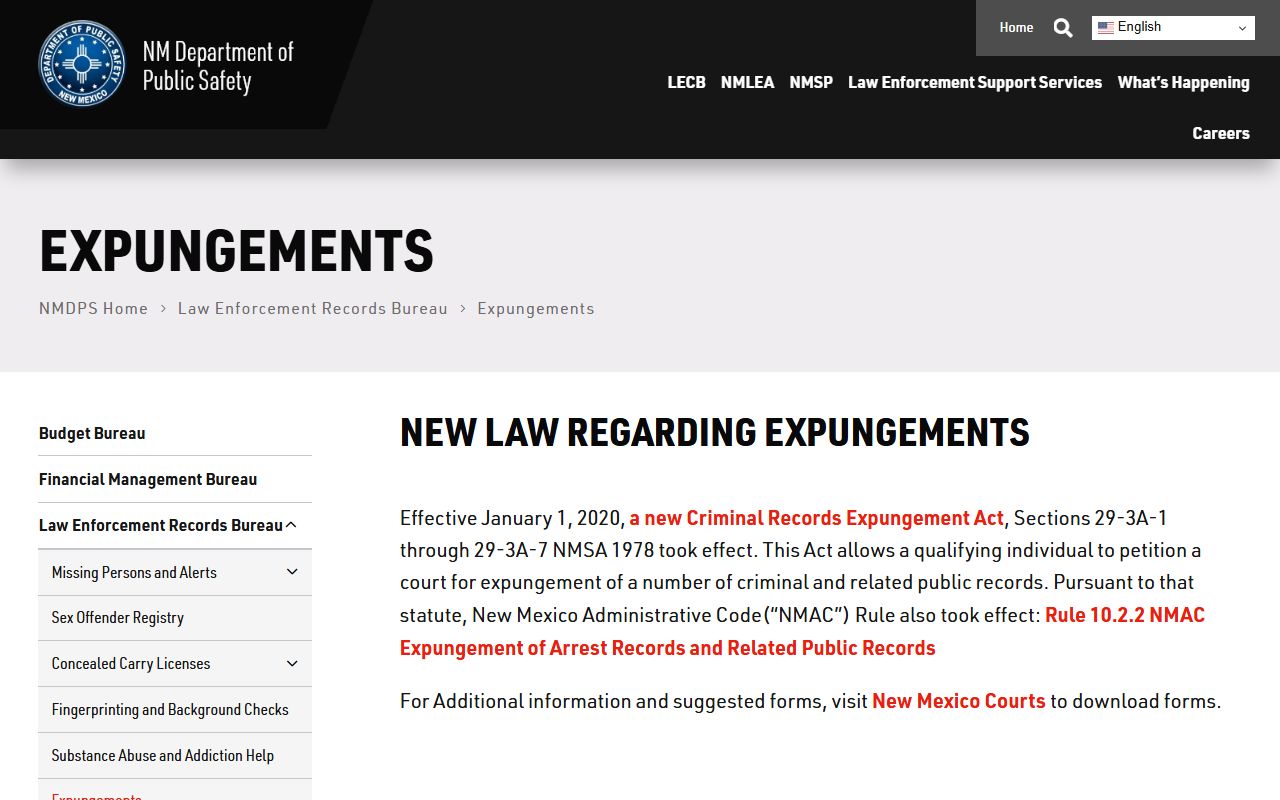
The DPS material confirms that expungement relief depends on statutory eligibility and a court order, not a simple public-search correction.
McKinley County Expungement Path
For a McKinley County criminal case, the person generally petitions the court that can grant relief. Non-conviction expungement is addressed by Section 29-3A-4. Conviction expungement is addressed by Section 29-3A-5. The petition should identify the arrest, complaint, information or indictment, case number, disposition, agencies that hold the record, and whether any charge or proceeding remains pending.
For conviction expungement, the research notes that the court must make statutory findings such as no pending charge or proceeding, justice served, restitution fulfilled, and required waiting periods met. If the court grants relief, the order is served on agencies that maintain the record. Then the qualifying record is removed from public access. The public search tool, court clerk, sheriff, and DPS do not erase records on their own without the order.
- Identify the criminal case number, court, disposition, and all agencies that hold related records.
- Determine whether the request is based on release without conviction or a conviction record.
- File the petition in the proper court and address pending-charge, restitution, waiting-period, and justice-served issues.
- Serve or notify the agencies required by the court process.
- After an order is granted, confirm that public court, law-enforcement, and DPS access is updated under the order.
Restricted McKinley County Criminal Records
Restricted criminal records require caution. Juvenile criminal cases do not display on Case Lookup. Children's Court delinquency is handled through restricted re:SearchNM access. Strict-confidentiality categories include abuse and neglect, families in need of court-ordered services, adoption, and mental health. Protection-order cases are also withheld from Case Lookup under the official notice captured in the research. Protected personal identifiers can be redacted, and unredacted records containing protected identifiers cannot be made available on public websites operated by or for a public body.
Some criminal records also become sensitive because of ongoing proceedings, warrants, bond conditions, or sealed filings. A public docket can show limited event text while the underlying document remains unavailable to the public. When a public search result seems incomplete, the court of record should be asked whether the case is restricted, sealed, expunged, too old for the public system, or available only through a formal records request.
The manifest includes the New Mexico Department of Justice petition announcement, a dated source that reflects the 2025 public transition context around the Eleventh Judicial District Attorney office serving McKinley County.
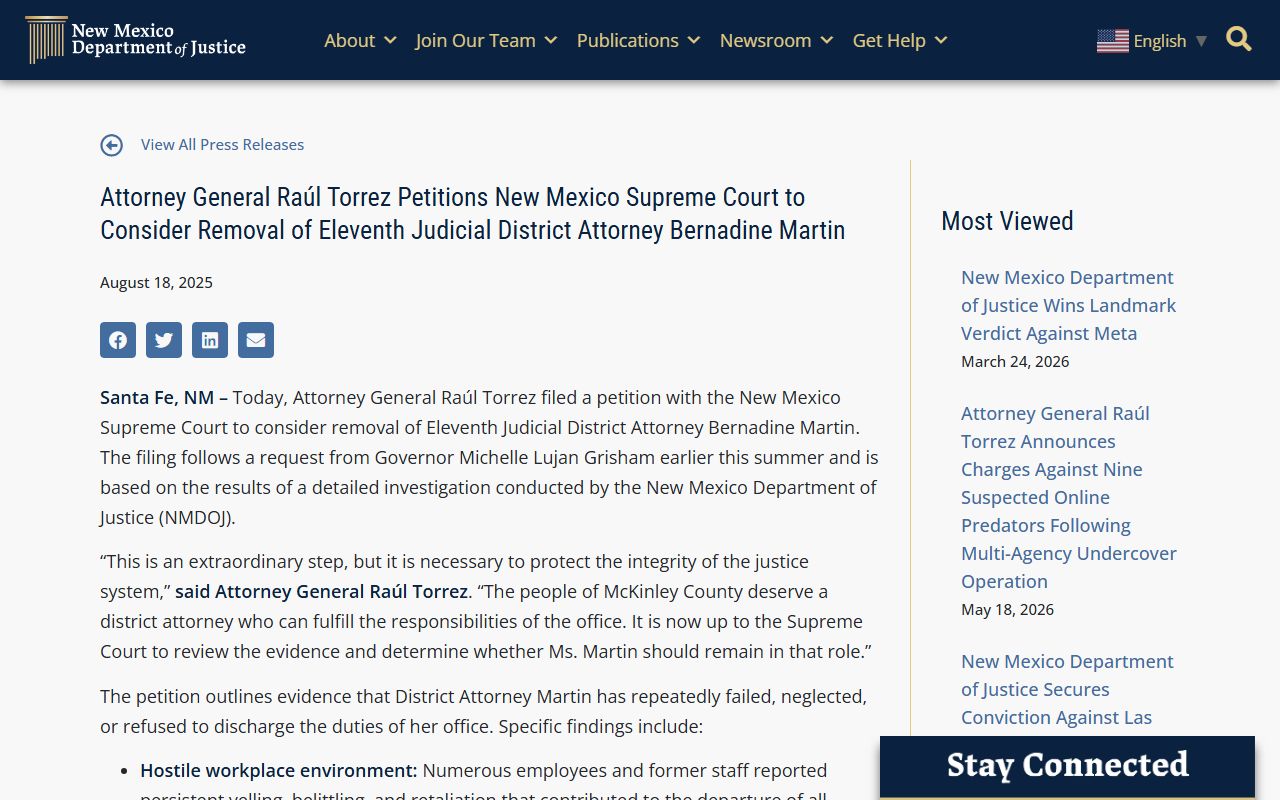
That prosecutorial context does not change a case file by itself, but it helps explain why official court records remain the controlling source for charges, dispositions, and sentencing.